



Cooperatives Build a Better World


India’s Economic Dilemma
Nearly eight decades after independence, India’s economic journey is still unfinished. The dream of modernization and formalization has remained elusive. Only about 7 percent of the workforce is employed in the formal sector. The vast majority of farmers, fishers, pastoralists, artisans, construction, transport and market workers, retail stores and restaurants workers, service sector and now gig workers currently operate in the informal economy, often with no organisational support, no bargaining power, and very little job and social security.
The question naturally arises: what kinds of organisational forms can help these workers live and work with dignity? Among the many models that have been tried by mutual help groups, producer companies, community organisations and aggregator networks and civil society initiatives, the cooperative model stands out for its ability to blend economic activity with democratic participation. REPRESENTATIVE IMAGE | PHOTO : WIKI COMMONS
The Cooperative Ideal
A cooperative is not simply a business. Nor is it charity. It is, in essence, an autonomous association of persons united voluntarily to meet their common economic, social, and cultural needs and aspirations through a jointly owned and democratically controlled enterprise.
Modern cooperatives are usually traced back to the Rochdale Pioneers of 1844 in England, a group of 28 weavers and artisans who, inspired by utopian socialist ideas of Robert Owen, set up a cooperative store to escape the exploitation of merchants. Their simple rules later evolved into the seven internationally recognised cooperative principles:
1. Voluntary and open membership
2. Democratic member control
3. Members’ economic participation
4. Autonomy and independence
5. Education, training, and information
6. Cooperation among cooperatives
7. Concern for community
Together, these principles ensure that cooperatives are people-centred organisations; enterprises with a social purpose, not profit-driven corporations in disguise ROBERT OWEN | PHOTO : WIKI COMMONS
The Indian Context
In India, cooperatives were first introduced under colonial rule through the Cooperative Societies Acts of 1904 and 1912, primarily to address rural indebtedness. After independence, they drew inspiration from Germany’s rural credit cooperatives and the Soviet model of producer cooperatives, with Kerala emerging as a vibrant site of experimentation after 1957, when the first democratically elected Communist government in the world came to power there.
From then on, cooperatives spread across diverse sectors: agriculture, dairy, banking, housing, fisheries, and labour contracting. Some became international success stories; Amul in Gujarat, which transformed India into the world’s largest farmer-owned cooperative, and the Uralungal Labour Contract Cooperative Society (ULCCS) in Kerala, today the largest labour cooperative in Asia.
But to understand the promise and the pitfalls of cooperatives in India, one must also look at smaller, more local stories. AMUL | PHOTO : WIKI COMMONS
Marianad: A Story from the Shore
My own professional journey began with the Marianad Malsya Ulpadaka Cooperative Society, a fishermen’s cooperative in coastal Kerala. Like many others, it started inauspiciously: as a “pocket society” created by officials and a local broker to access government benefits.
But the story took a turn when fishers, weary of being forced to sell their catch to merchants at low prices, decided to take control. They discovered the dormant cooperative and “bought” it from the promoter, turning it into their own.
From that moment, the cooperative became a tool for genuine change. A system of collective credit allowed fishers to purchase better equipment, raising productivity. Marketing was organised through auctions on the shore, with receipts and small advances issued to fishers’ families. Payments at the cooperative office were carefully structured: compulsory savings, a cooperative commission, and loan repayments were deducted before cash was handed over.
This created a virtuous cycle → Credit → Production → Marketing → Savings; which not only raised incomes but also built security and dignity.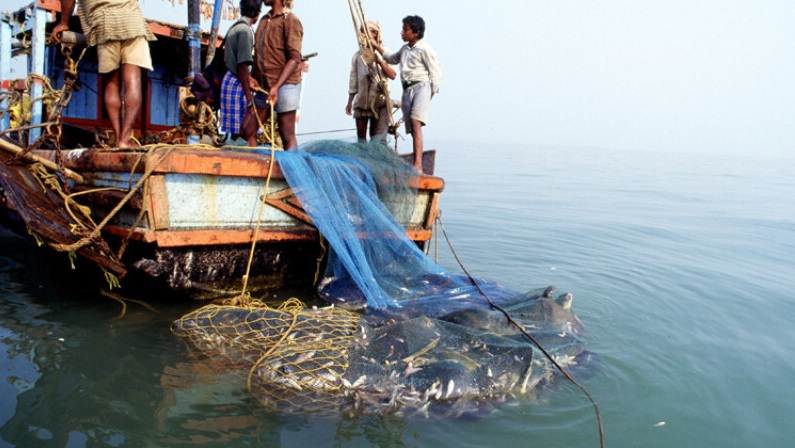 REPRESENTATIVE IMAGE | WIKI COMMONS
Beyond Fishing
The Marianad Cooperative expanded steadily:
- Providing credit through bank linkages and asset pawning schemes
- Marketing fish for local and export markets
- Selling fishing gear and essentials
- Running a consumer store for the entire community
- Training youth in leadership and cooperative management
- Spreading the idea along the Kerala coast, ultimately contributing to the creation of the South Indian Federation of Fishermen Societies (SIFFS)
The Kerala Government’s Economic Review of 1977 called Marianad “an eye opener,” crediting its success to the fishers’ felt need for unity and the presence of dedicated leadership.
In 1985, when Kerala State wound up over a thousand failing fisheries cooperatives, it established MATSYFED, explicitly modelled on Marianad. Units of the new MATSYAFED cooperatives in Marianad have since won the President’s Award for Best Village Fishery Cooperative three times. MATSYAFED | PHOTO : WIKI COMMONS
Strengths and Weaknesses
The strengths of the cooperative model are clear:
- It is rooted in globally accepted principles.
- It resonates with the customary ethos of rural producers and informal workers.
- It builds solidarity and self-reliance, not just profit.
- India already has the legal and organisational infrastructure to support it.
But the weaknesses are equally evident:
- Too many cooperatives are formed from above, rather than emerging from people’s needs.
- Genuine democratic control and autonomy are often missing.
- Excessive government interference and party politics have undermined independence.
-Many cooperatives forget their social purpose, functioning only as businesses.
Where principles are upheld, success is almost inevitable. Where they are ignored, failure is almost guaranteed.
The Road Ahead
India has produced some of the best cooperatives in the world, Amul and ULCCS are proof of that. Yet it has also witnessed countless failures. The lesson is not to abandon the cooperative model but to deepen it, to ensure fidelity to its principles, and to tailor it to the realities of today’s occupational groups, from fishers and farmers to gig workers and service providers.
The stakes are high. In an era when economic growth coexists with insecurity for millions, cooperatives remain one of the few organisational forms that put people at the centre of development.
Cooperatives have failed, but cooperatives must succeed.
John Kurien is a reflective practitioner who has helped organise cooperatives for small-scale fishers. He resides in Kozhikode.